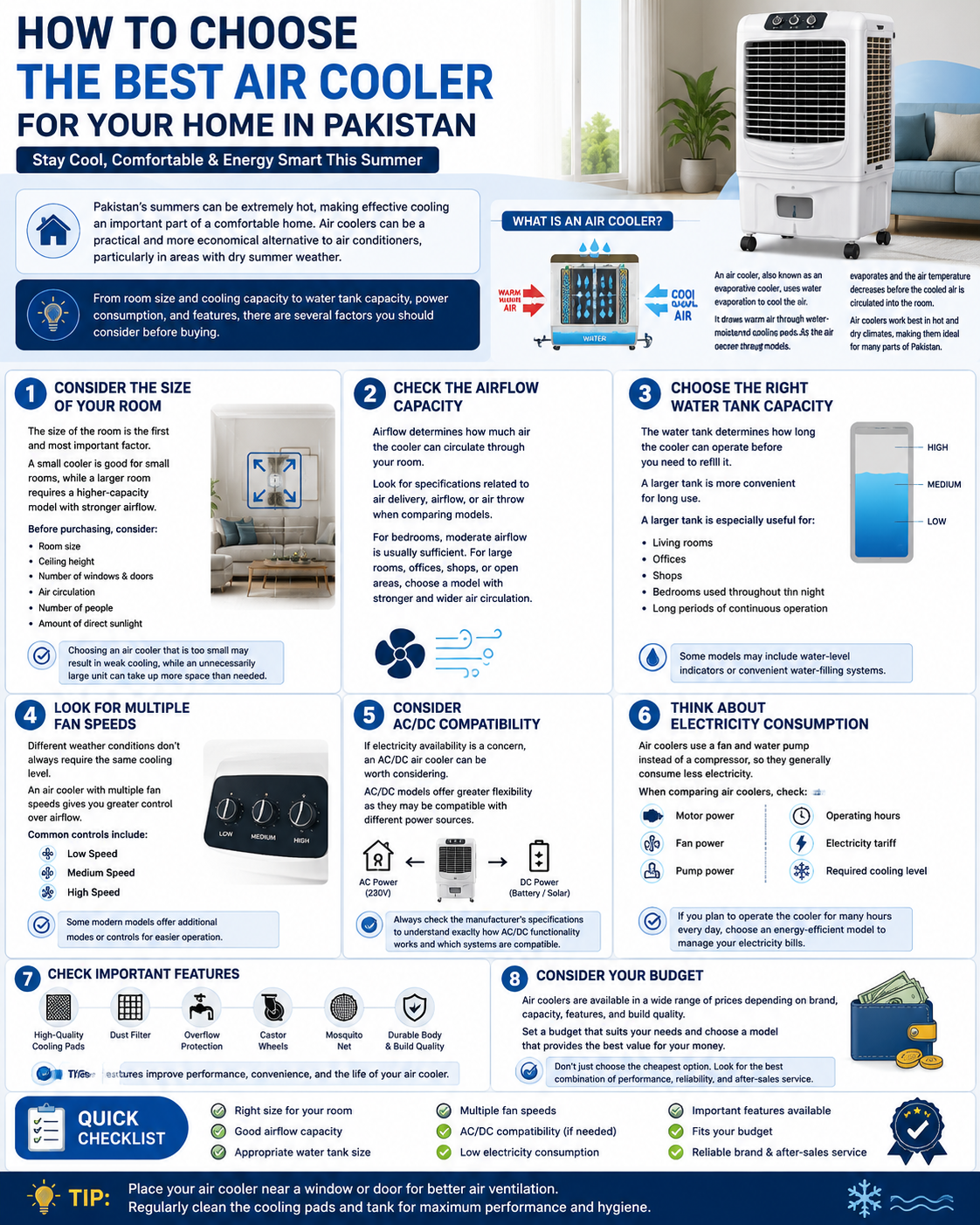
Pakistan’s summers can be extremely hot, making effective cooling an important part of a comfortable home. While air conditioners provide powerful cooling, they can also consume significant electricity. For many households, an air cooler can be a practical and more economical alternative, particularly in areas with dry summer weather.
But with so many air coolers available in the market, how do you know which one is right for your home?
From room size and cooling capacity to water tank capacity, power consumption, and features, there are several factors you should consider before buying. In this guide, we explain how to choose the best air cooler for your home in Pakistan.
What Is an Air Cooler?
An air cooler, also known as an evaporative cooler, uses water evaporation to cool the air.
Unlike an air conditioner, which uses a refrigeration system, an air cooler draws warm air through water-moistened cooling pads. As the air passes through these pads, water evaporates and the air temperature can decrease before the cooled air is circulated into the room.
Air coolers work particularly well in hot and dry climates, making them a useful cooling solution for many parts of Pakistan.
1. Consider the Size of Your Room
The first thing you should consider when buying an air cooler is the size of the room where you plan to use it.
A small air cooler may work well in a bedroom, study, or small office, while a larger room or living area may require a higher-capacity model with stronger airflow.
Before purchasing, consider:
- Room size
- Ceiling height
- Number of windows and doors
- Air circulation
- Number of people normally occupying the room
- Amount of direct sunlight entering the room
Choosing an air cooler that is too small may result in weak cooling, while an unnecessarily large unit can take up more space than needed.
2. Check the Airflow Capacity
Airflow is one of the most important specifications when comparing air coolers.
It determines how much air the cooler can circulate through your room. A model with stronger airflow can generally distribute cooled air more effectively across a larger space.
Look for specifications related to air delivery, airflow, or air throw when comparing different models.
For bedrooms and smaller rooms, moderate airflow may be sufficient. For large living rooms, shops, offices, or open areas, you may want a model designed for stronger and wider air circulation.
3. Choose the Right Water Tank Capacity
The water tank determines how long the cooler can operate before you need to refill it.
A smaller tank can be suitable if you are using the cooler for short periods or in a small room. However, if you plan to operate your air cooler throughout the day, a larger water tank can be more convenient.
When choosing a model, consider how frequently you want to refill the tank.
A larger tank is especially useful for:
- Living rooms
- Offices
- Shops
- Bedrooms used throughout the night
- Long periods of continuous operation
Some models may also include water-level indicators or convenient water-filling systems.
4. Look for Multiple Fan Speeds
Different weather conditions don’t always require the same cooling level.
An air cooler with multiple fan speeds gives you greater control over airflow. You can use a lower speed when the temperature is comfortable and increase the speed during extremely hot periods.
Common controls may include:
- Low speed
- Medium speed
- High speed
Some modern models offer additional modes or controls that make operation easier.
5. Consider AC/DC Compatibility
If electricity availability is a concern in your area, an AC/DC air cooler can be worth considering.
AC/DC models can offer greater flexibility because they may be compatible with different power sources, depending on the specific model and its specifications.
This can be particularly useful in Pakistan where some households use alternative power systems such as solar solutions or backup batteries.
Before purchasing, always check the manufacturer’s specifications to understand exactly how the AC/DC functionality works and what type of backup system is compatible with the cooler.
6. Think About Electricity Consumption
One of the reasons many people consider air coolers instead of air conditioners is energy consumption.
Air coolers generally use a fan and water pump rather than a compressor-based refrigeration system. As a result, they can be a lower-energy cooling option in suitable conditions.
However, actual electricity consumption varies between models.
When comparing air coolers, check:
- Motor power
- Fan power
- Pump power
- Operating hours
- Electricity tariff
- Required cooling level
If you plan to operate the cooler for many hours every day, choosing an energy-efficient model can help manage your electricity usage.
7. Consider Your Local Climate
This is one of the most important points people sometimes overlook.
Air coolers work through evaporative cooling, which means their effectiveness depends on the surrounding humidity.
They generally perform better in hot, dry conditions. In areas with high humidity, the cooling effect may be less noticeable because the air already contains a significant amount of moisture.
Pakistan has different climate conditions across its regions, so consider your local weather before choosing an air cooler.
If you live in a relatively dry area, an evaporative cooler can be a very effective option.
8. Check the Cooling Pads
Cooling pads are an important component of an evaporative air cooler.
They hold water and allow warm air to pass through a moist surface, helping evaporation take place.
When purchasing an air cooler, consider the type and quality of cooling pads used by the model. Good-quality pads can contribute to effective cooling and airflow.
Regular cleaning and maintenance are also important because dust and mineral deposits can accumulate over time.
9. Consider Noise Levels
If you’re buying an air cooler for a bedroom, noise should be another consideration.
A powerful motor and fan can sometimes produce more operating noise. For bedrooms, study rooms, and offices, you may prefer a model designed for quieter operation.
If possible, check the manufacturer’s noise specifications or product information before purchasing.
A quieter air cooler can make a noticeable difference when you’re sleeping, working, or studying.
10. Look at Portability and Design
Think about where you will use your cooler.
If you plan to move it between rooms, look for features such as wheels, handles, or a compact design.
A portable air cooler can allow you to move the unit from the bedroom to the living room or another area when required.
For a fixed location, size and appearance may be more important considerations.
Air Cooler vs Air Conditioner: Which Should You Choose?
Both air coolers and air conditioners have their advantages.
An air conditioner generally provides stronger and more controlled cooling and can reduce both temperature and humidity. However, it usually requires more electricity and involves a more complex installation.
An air cooler can be a practical choice when:
- You want lower-energy cooling.
- Your area has a hot and relatively dry climate.
- You want a portable cooling solution.
- You don’t want permanent AC installation.
- You have limited cooling requirements.
- You want to use a cooling appliance with a relatively simple operating system.
For extremely humid environments, however, an air conditioner may provide better comfort.
How to Maintain Your Air Cooler
Buying the right air cooler is only part of the process. Regular maintenance can help keep it working efficiently.
Here are some useful maintenance tips:
Clean the Water Tank Regularly
Empty and clean the tank regularly to reduce dirt, deposits, and unpleasant smells.
Clean the Cooling Pads
Dust and mineral deposits can reduce airflow and cooling performance. Follow the manufacturer’s instructions for cleaning or replacing the pads.
Keep the Air Cooler Ventilated
Unlike an AC, an evaporative cooler works best when there is adequate air circulation. Keep a window or door partially open where appropriate so that humid air can escape.
Check the Water Pump
Make sure the water pump is functioning correctly and that water is reaching the cooling pads.
Clean the Fan and Air Intake
Dust can accumulate around the air intake and fan. Regular cleaning can help maintain airflow.
What Is the Best Air Cooler for Your Home?
There is no single air cooler that is best for every household.
The right model depends on your room size, climate, airflow requirements, water capacity, electricity supply, and budget.
For a small bedroom, you may prefer a compact model with moderate airflow and a smaller tank. For a large living room or office, a high-airflow model with a larger water tank may be more appropriate.
If you experience power interruptions or use solar or backup electricity systems, you may also want to consider an AC/DC air cooler.
Final Thoughts
Choosing the best air cooler in Pakistan doesn’t have to be complicated. Start by understanding your room size and local climate, then compare airflow, water tank capacity, power consumption, cooling pads, fan speeds, portability, and available features.
An air cooler can be an excellent cooling solution for hot and dry Pakistani summers, especially for households looking for an alternative to traditional air conditioning.
At KSC Appliances, you can explore air cooling solutions designed for different household requirements. Compare the available models and choose an air cooler that provides the right combination of cooling performance, convenience, energy use, and features for your home.
Looking for an air cooler for your home? Explore KSC Appliances’ air cooler range and find the right cooling solution for your needs.